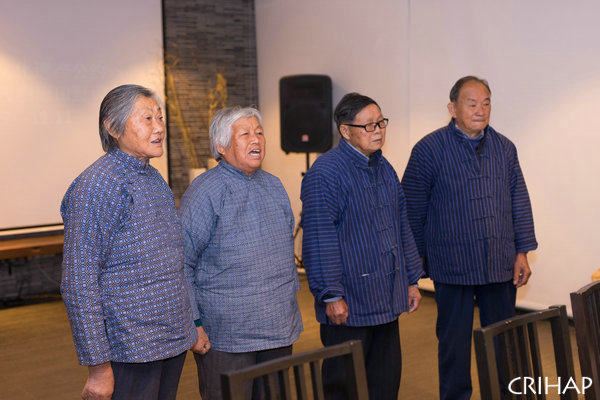
Qingpu Farming Song
Introduction
Qingpu Farming Song is a traditional folk music genre primarily popular in the Qingpu district of Shanghai, China. In 2008, it was included in the national list of intangible cultural heritage expansion projects. It is predominantly sung in the towns of Liantang, Zhaoxiang, Jinze, Shangta, and Zhujiajiao. Additionally, the genre extends its influence to neighboring rice-growing areas such as Songjiang, Jinshan, and Fengxian districts of Shanghai, Wujiang county in Jiangsu province, and Jiashan county in Zhejiang province. Farming Song is deeply rooted in the agricultural lifestyle and reflects the cultural heritage of the local farming communities.
Performance Style
Qingpu Farming Song is characterized by its unique performance style, which involves farmers singing in paddy fields. Typically, one person takes the lead, and others follow sequentially. The performance style varies across different towns, with notable examples being the Zhaoxiang and Liantang Farming Songs.
Zhaoxiang Farming Song
Known as "yao-mai song," the Zhaoxiang Farming Song is composed of several distinct parts:
Touge: The starting song.
Qianmai: The first continuing solo.
Qianliao: The first lingering sounds.
Fachangshen: A longer solo.
Ganlaoya: A chorus.
Houmai: The second continuing solo.
Houliao: The second lingering sounds.
Xiesheng: The final chorus.
Liantang Farming Song
Referred to as the "rice seedling song," the Liantang Farming Song consists of three main parts:
Touge: The leading solo.
Maige: A male chorus.
Liaoge: A female chorus.
The Liantang Farming Song is often performed repeatedly, showcasing its cyclical and harmonious nature.
Musical Characteristics
The Qingpu Farming Song is distinguished by its soaring vocal range and unbalanced melody. Performers often raise their voices by one octave during the performance. The songs are sung with tempo rubato, resulting in prolonged tunes and a dynamic rhythm. Although the songs are typically monophonic, they incorporate overlapping phrases, creating an effect of two-vocal harmony. This harmony is achieved through intervals such as the same pitch, octave, fourth, or fifth. Occasionally, inharmonious consonances like the second or seventh key are introduced, adding a unique polyphonic texture to the music.
Themes
The lyrics of Shanghai Farming Songs are vibrant and deeply rooted in the real-life experiences of local people. The themes encompass labor, daily life, thoughts, and love. For instance, love-themed songs include "Expecting of my love day and night," "I will marry you even you are poor in Qingpu," and the long narrative "Song of the Poplar Village" from Fengxian.
The entire poem, including its prelude and postlude, comprises over 3100 vivid and lively lines, showcasing the rich storytelling tradition of Qingpu Farming Songs.








